One Scripture. Three Great Acharyas. Three Different Answers.
For centuries, followers of Adi Shankaracharya, Sri Ramanujacharya, and Sri Madhvacharya have passionately debated one question:
Each tradition firmly believes that its Acharya correctly understood Krishna's teachings. Each quotes verses directly from the Gita. Each presents profound logic. Each has inspired millions of sincere seekers.
So how can three great Acharyas, studying the same scripture, arrive at three different conclusions? The answer may lie in the extraordinary depth of the Bhagavad Gita itself — a text that speaks to devotion, duty, knowledge, meditation, surrender, action, and liberation simultaneously.
Sri Ramanujacharya
Why Vishishtadvaita Feels Closest
The Middle Path — Qualified Non-Dualism
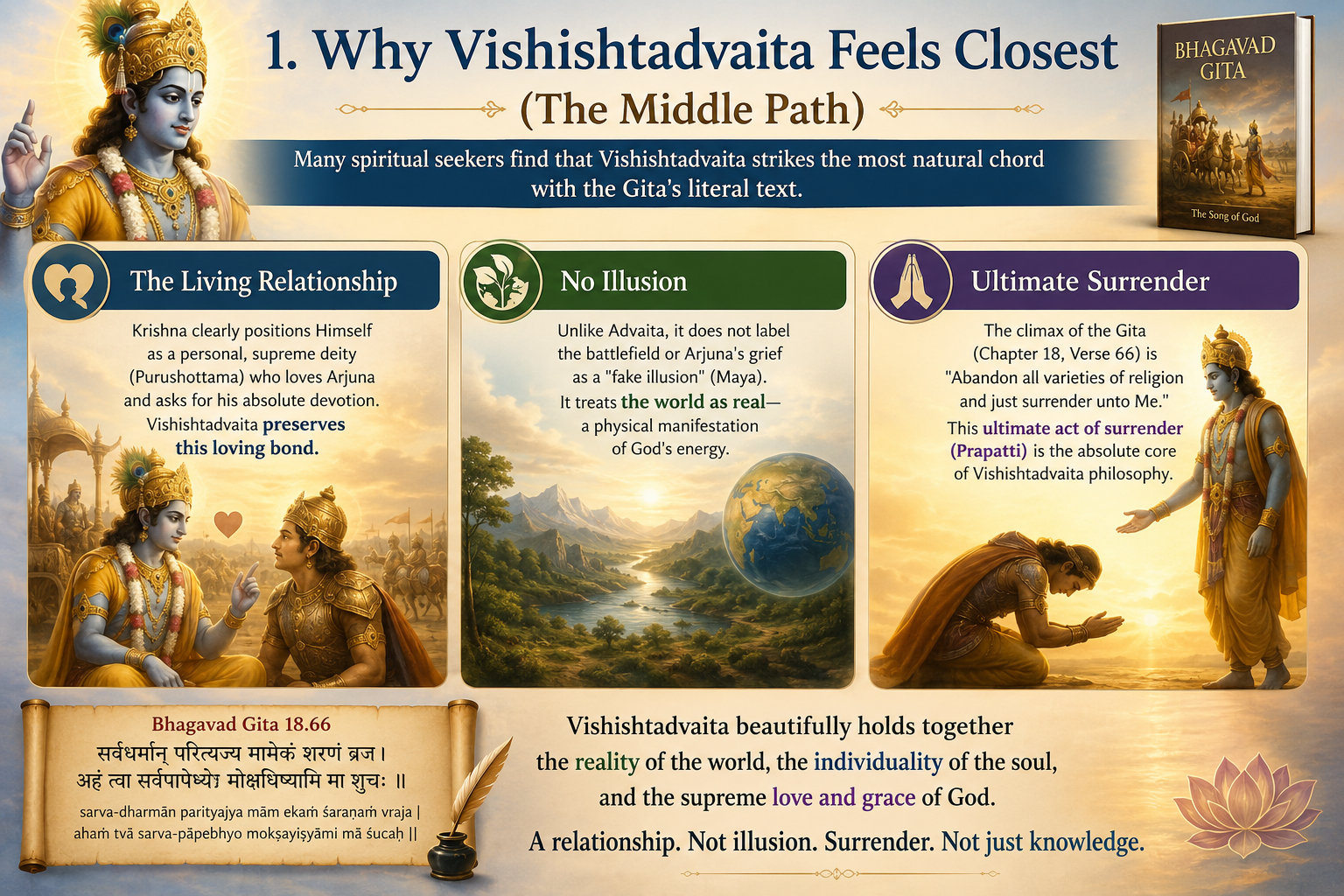
The Living Relationship
Throughout the Gita, Krishna presents Himself as the Supreme Person (Purushottama) who loves His devotees and invites them into a personal relationship. He repeatedly asks Arjuna to remember Him, worship Him, love Him, surrender to Him. Vishishtadvaita preserves this loving bond intact — God is not a concept but a Person.
The Reality of the World
Unlike Advaita, Vishishtadvaita does not regard the world as merely an illusion. The battlefield of Kurukshetra is real. Arjuna's confusion is real. The universe itself is understood as a manifestation of God's divine body and energy. This resonates naturally with how the Gita unfolds — in a real world, with real choices.
The Ultimate Teaching: Complete Surrender
Perhaps the most famous verse in the Gita is Chapter 18, Verse 66. For Sri Ramanujacharya, this verse represents the very heart of the teaching. Complete surrender — Prapatti — becomes the highest means of attaining God.
"Vishishtadvaita beautifully holds together the reality of the world, the individuality of the soul, and the supreme love and grace of God."
A relationship. Not illusion. Surrender. Not just knowledge.Sri Madhvacharya
Why Dvaita Feels Closest
The Path of Bhakti — Eternal Dualism
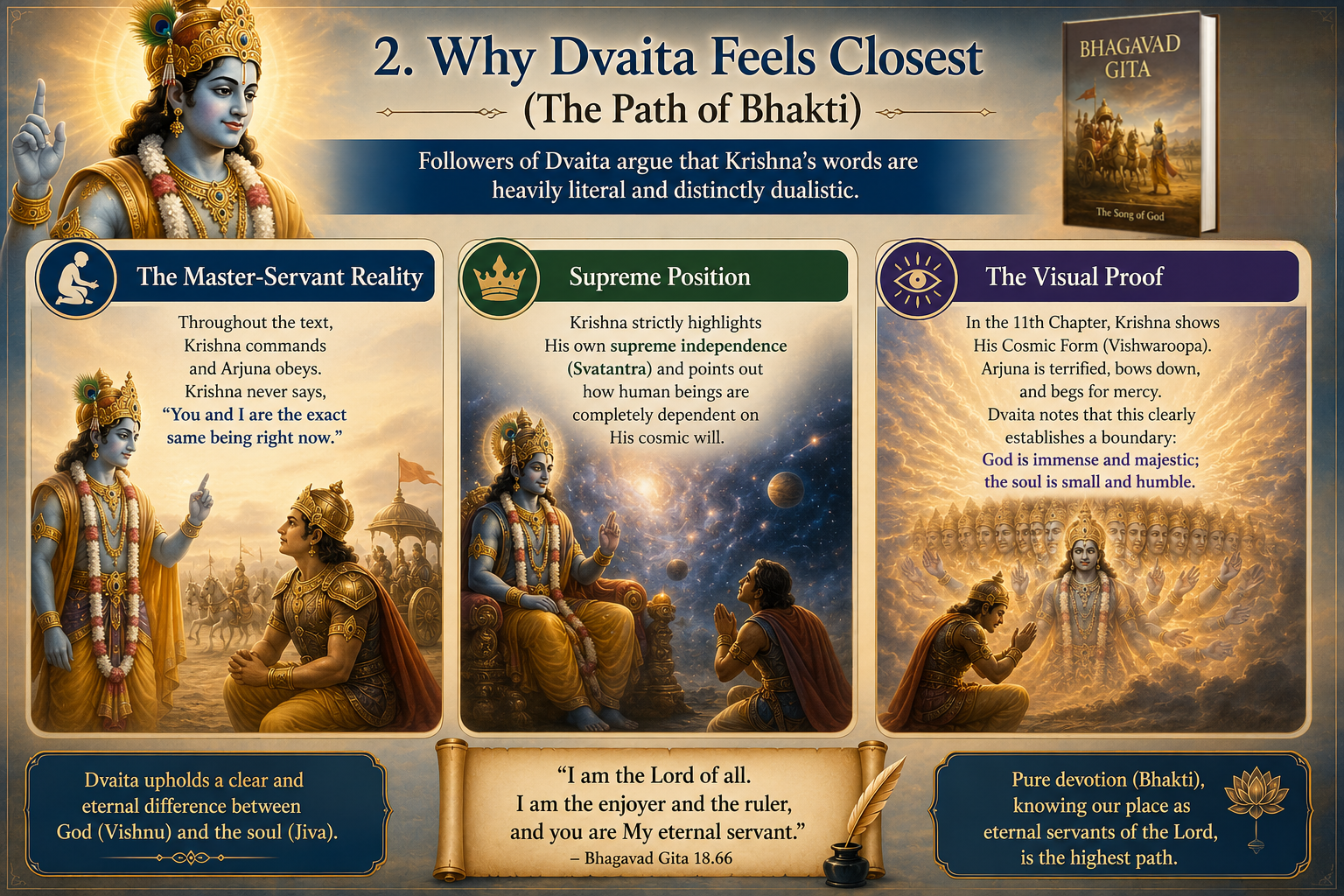
The Eternal Relationship Between Master and Servant
Throughout the Gita's dialogue: Krishna teaches, Arjuna listens. Krishna commands, Arjuna obeys. Nowhere does Krishna explicitly tell Arjuna, "You and I are already identical." Instead, Krishna consistently presents Himself as the Supreme Lord and Arjuna as His devotee — a distinction that Dvaita holds is eternal and real.
God's Supreme Independence
Krishna repeatedly declares His supreme position. He controls nature, sustains the universe, and everything ultimately depends upon Him. Human beings remain completely dependent upon God's will. For Madhvacharya, this eternal distinction between God and the individual soul is one of the central teachings of the Gita.
The Vishwaroopa: Visual Proof
Chapter 11 provides one of the strongest foundations for Dvaita. When Krishna reveals His Cosmic Form, Arjuna is overwhelmed — he trembles, bows down, begs forgiveness. The difference between the Infinite Lord and the finite soul becomes dramatically visible. For Dvaita, this is clear evidence that God and the soul remain eternally distinct.
"I am the Lord of all. I am the enjoyer and the ruler, and you are My eternal servant."
Bhagavad Gita 18.66 — interpreted through DvaitaAdi Shankaracharya
Why Advaita Feels Closest
The Path of Ultimate Truth — Non-Dualism
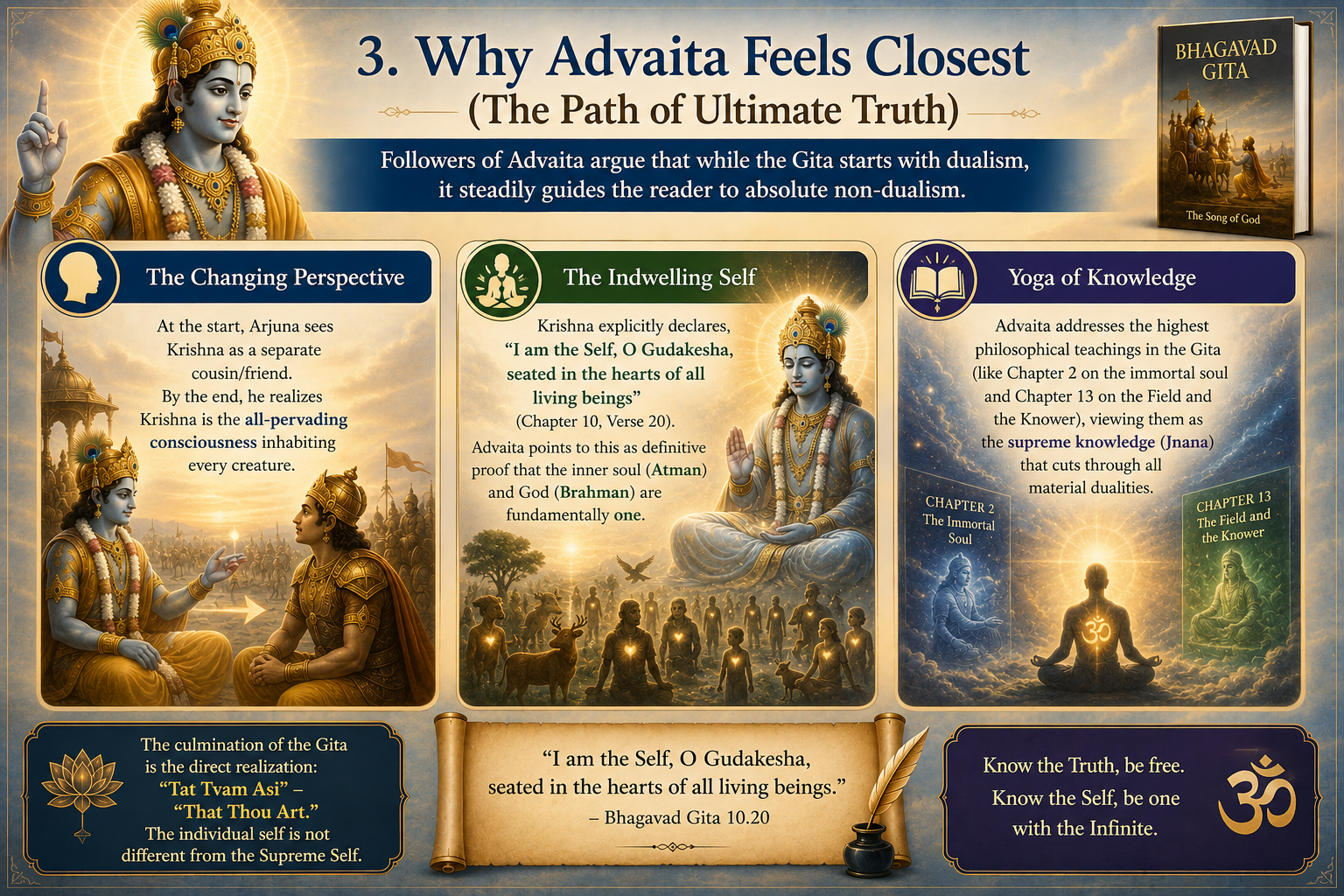
A Gradual Transformation
At the beginning of the Gita, Arjuna sees Krishna as his cousin, friend, and charioteer. As the dialogue unfolds, Krishna gradually reveals His universal nature. The relationship evolves from seeing God as external to recognizing the Divine as the very essence of all existence. Advaita reads this as a deliberate pedagogical movement from duality toward non-duality.
"I Am the Self"
One of the most significant verses for Advaita is Bhagavad Gita 10.20: "I am the Self, O Gudakesha, seated in the hearts of all living beings." Advaita interprets this as pointing toward the essential unity of Atman and Brahman. The Divine is not merely outside us — the Divine is the innermost Self.
The Yoga of Knowledge
Advaita draws heavily from Krishna's teachings on the immortal Self (Chapter 2), the Field and the Knower of the Field (Chapter 13), and the knowledge that destroys ignorance. According to Shankaracharya, these teachings culminate in the direct realization: Tat Tvam Asi — That Thou Art.
"I am the Self, O Gudakesha, seated in the hearts of all living beings."
Bhagavad Gita 10.20The Synthesis
The Ladder of Consciousness
Many great saints — including Sri Ramakrishna Paramahamsa — suggested that these three systems are not contradictory, but rather progressive stages of spiritual maturity.
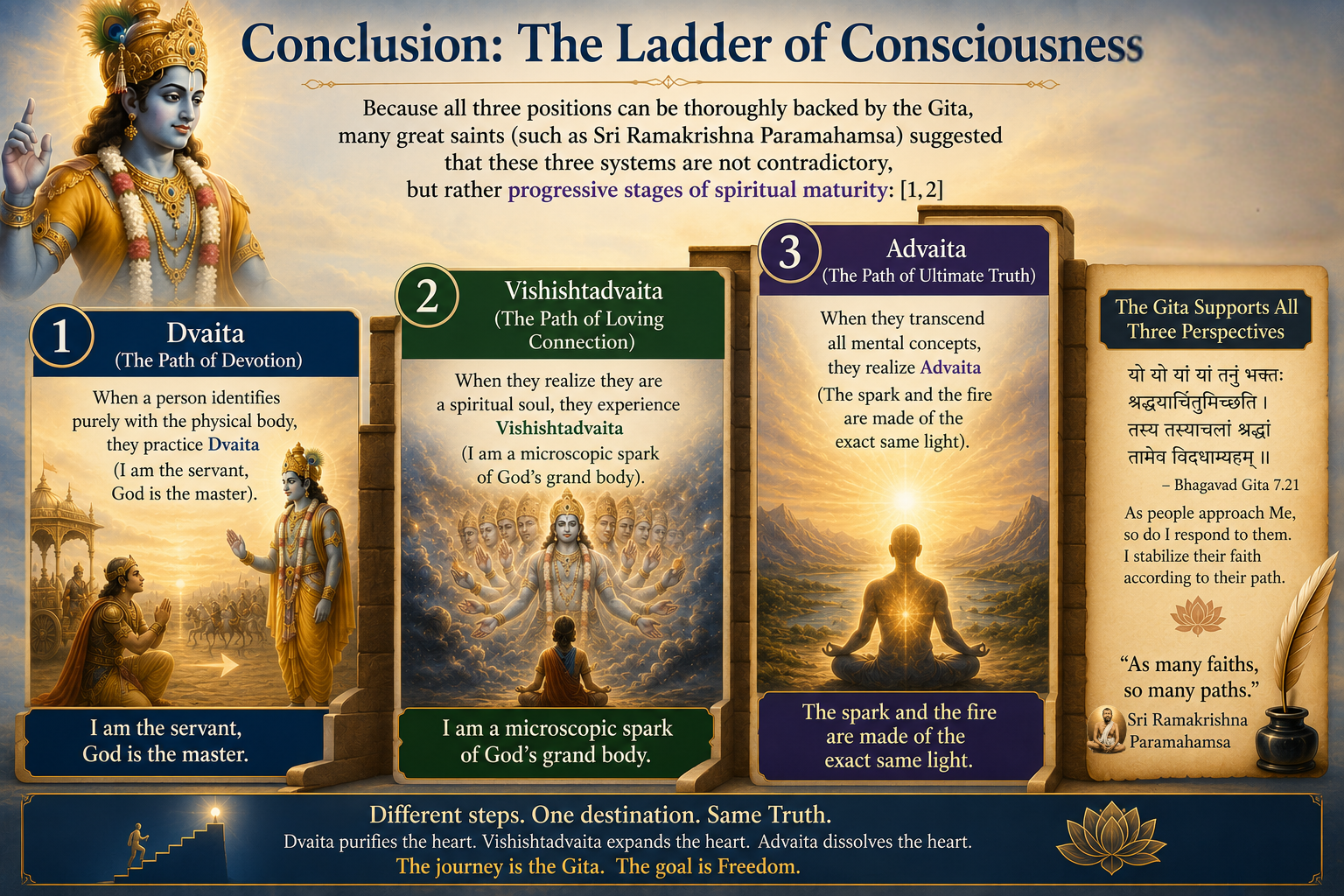
When we identify primarily with the body and individual personality, we naturally approach God as our Lord. This develops humility, devotion, discipline, and surrender.
As spiritual understanding deepens, we realize we are eternal souls inseparably connected to God. Love becomes more intimate. Surrender becomes joyful.
At the highest level of contemplative realization, all limiting concepts disappear. The seeker experiences only the one infinite Reality.
Note: This ladder is one interpretive model, not a universally accepted conclusion. Many followers of each tradition maintain that their own philosophy expresses the highest and final truth.
A Reflection
Three Students. One Mountain.
A Message to Followers of All Three Traditions
Perhaps the greater question is not: "Which Acharya defeated the others?"
Instead, Krishna invites each of us to ask ourselves:
Because regardless of philosophical differences, all three Acharyas dedicated their entire lives to leading humanity toward God. If studying their teachings makes us more loving, more disciplined, and more spiritually awakened — then we are honoring their legacy.